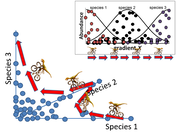
The Big Three Challenges in Ecological Community Analysis. (Three Short Videos)
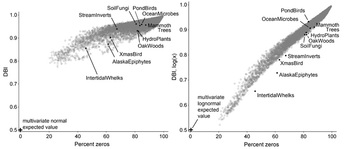
McCune, B. & H. T. Root. 2015. Origin of the dust bunny distribution in ecological community data. Plant Ecology 216: 645-656. doi:10.1007/s11258-014.0404-1
Complete manuscript as accepted by the journal Plant Ecology
Supplemental online resources (appendices)
Fortran source code for multispecies population model to generate communities (DustBunny.f90).
Example file with input parameters for above (DustBunnyOpt.txt)
Complete manuscript as accepted by the journal Plant Ecology
Supplemental online resources (appendices)
Fortran source code for multispecies population model to generate communities (DustBunny.f90).
Example file with input parameters for above (DustBunnyOpt.txt)

McCune, B. and J. B. Grace. 2002. Analysis of Ecological Communities. MjM Software, Gleneden Beach, Oregon, USA (www.pcord.com) 304 pages. With a contribution by Dean L. Urban.
ISBN: 0-9721290-0-6
More information
Download powerpoints with tables and figures (select chapters)
Errata
ISBN: 0-9721290-0-6
More information
Download powerpoints with tables and figures (select chapters)
Errata
PC-ORD Version 7 Multivariate Analysis of Ecological Data
Software for multivariate statistical analysis of ecological communities. Includes cluster analysis, ordination, 3D graphics, and species diversity.
Demo video Version 7 (maximize YouTube window for readability)
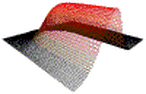
HyperNiche Version 2 Multiplicative Habitat Modeling
Software for habitat modeling and nonparametric regression where the predictors are combined multiplicatively (NPMR) rather than additively. Includes cross-validation, 3D graphics, and GIS input/output.
Demo video (maximize YouTube window for readability).
Journal article on NPMR
Applications outside of ecology: an interesting application of NPMR to neuroscience.
Software for habitat modeling and nonparametric regression where the predictors are combined multiplicatively (NPMR) rather than additively. Includes cross-validation, 3D graphics, and GIS input/output.
Demo video (maximize YouTube window for readability).
Journal article on NPMR
Applications outside of ecology: an interesting application of NPMR to neuroscience.
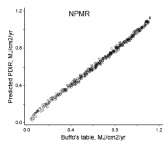
Equations for estimating potential direct incident radiation and heat load, based on latitude, aspect, and slope.
These are based on:
McCune, B. 2007. Improved estimates of incident radiation and heat load using non-parametric regression against topographic variables. Journal of Vegetation Science 18:751-754.
McCune, B. and D. Keon. 2002. Equations for potential annual direct incident radiation and heat load. Journal of Vegetation Science 13:603-606.
These are based on:
McCune, B. 2007. Improved estimates of incident radiation and heat load using non-parametric regression against topographic variables. Journal of Vegetation Science 18:751-754.
McCune, B. and D. Keon. 2002. Equations for potential annual direct incident radiation and heat load. Journal of Vegetation Science 13:603-606.
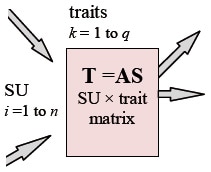
Building a sample unit x species trait matrix in ecology.
See: McCune, B. 2015. The front door to the fourth corner: variations on the sample unit × trait matrix in community ecology. Community Ecology 16:267-271. See implementation of the various options in PC-ORD 7 traits menu (Traits | Calculate SU x Traits Matrix): |
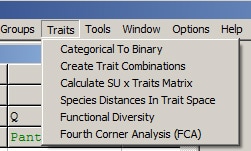
|
